SYNTH & PEDAL EXPO in PORTLAND

It’s warming up out there, which means we’re getting closer to the Synth & Pedal Stompbox Exhibit! We’re going to three pedal shows this year, and the first one is just a few weeks away. Catch us at the Synth & Pedal Expo on April 11-12, 2026, in Portland, OR. We’ll have our demo boards set up so you can check out our pedals and chat with our product specialists. Jim Pennock will be there too, showing off how the pedals work and ready to answer any questions you might have. Be sure to swing by and say hi!
Product Spotlight: DOD Rubberneck Analog Delay
This month, we’re inspired to explore a pedal that emerged in 2016 and transformed the landscape of analog delay pedals. By pushing the boundaries of BBD chip capabilities and introducing tap tempo functionality to analog delays, the DOD Rubberneck paved the way for innovation. While these features are now common, its release was groundbreaking. So, let’s embark on an exciting journey into the world of the DOD Rubberneck Analog Delay.

The DOD Rubberneck Analog Delay quickly earned its reputation as one of the most expressive analog delays ever released by DOD. Designed for players who love warm, organic repeats but also want deep control, the pedal blends classic bucket-brigade delay technology with modern flexibility. At it’s heart, the Rubberneck delivers rich, musical echoes that naturally degrade with each repeat, creating the kind of dimensional ambience guitarists have loved since the earliest analog delay units. Whether used for subtle slapback or atmospheric soundscapes, the Rubberneck captures the character of vintage delay while giving players far more creative options underfoot.
The pedal’s warm tone comes from its use of bucket-brigade device (BBD) chips, the same analog technology that powered many legendary delays of the past. These chips pass the signal through a chain of capacitors, creating a naturally darkening and slightly compressed repeat that feels alive compared to digital delays. The Rubberneck features dedicated Time, Repeats, and Level controls, along with a Gain and Tone section that allows players to shape the character of the repeats themselves. A standout feature is the “Rubbernecking” effect, activated by a footswitch that momentarily bends the delay time, producing dramatic pitch-shifting swoops and tape-style warbles reminiscent of classic studio tricks.
What truly makes the Rubberneck stand out is how much performance control it puts in the hands—and feet—of the player. The pedal includes tap tempo, an effects loop for the repeats, and controls for modulation depth and rate, allowing musicians to add chorus-like movement directly to the delay trail. These creative tools transform the Rubberneck from a simple echo unit into a full sound-design platform. By combining authentic BBD warmth with innovative features rarely found on analog delays, the Rubberneck became a modern classic—proving that vintage tone and forward-thinking design can coexist beautifully in one stompbox.
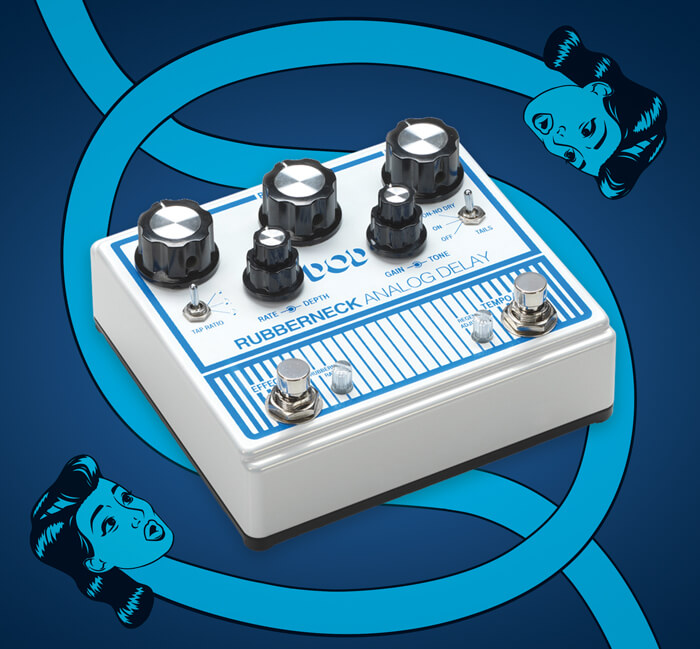
Rubbernecking: The Signature Pitch-Bending Magic
One of the most exciting features of the DOD Rubberneck Analog Delay is the pedal’s namesake effect: Rubbernecking. Inspired by the unpredictable pitch swoops of vintage tape delays, this feature allows players to momentarily stretch or compress the delay time while the repeats are already in motion. By holding down the Rubberneck footswitch, the delay time bends dramatically, causing the echoes to rise or fall in pitch just like slowing down or speeding up an old tape machine. The result is a wild, expressive effect that turns a simple delay line into a living, breathing instrument.
Unlike traditional delay pedals that keep the repeats locked in place, the Rubberneck’s pitch-bending capability encourages real-time experimentation. Guitarists can dive into dramatic pitch dives, warped echoes, and psychedelic sweeps simply by pressing the Rubberneck switch and adjusting the Time control. Because the pedal uses analog bucket-brigade circuitry, the pitch shifting feels smooth and organic rather than digital or artificial. It creates the kind of sonic chaos that experimental players and ambient guitarists love—perfect for dramatic transitions, noise textures, or those moments when a song needs something unexpected.
What makes this feature truly special is how playable it is on stage. The Rubbernecking effect can be performed live with your foot, allowing musicians to manipulate the delay trails like a studio engineer riding a tape machine in real time. Combined with the pedal’s warm analog tone and deep control set, the Rubbernecking function helps the DOD Rubberneck Analog Delay stand out as more than just a delay pedal—it’s a creative performance tool that brings movement, character, and a little bit of sonic mischief to any rig.
Here is a video of our friend Jack Fossett checking out the DOD Rubberneck Analog Delay.
Also check out this ORIGIN STORY told by Tom Cram.
Vintage Spotlight: DOD FX17 Volume / WAH
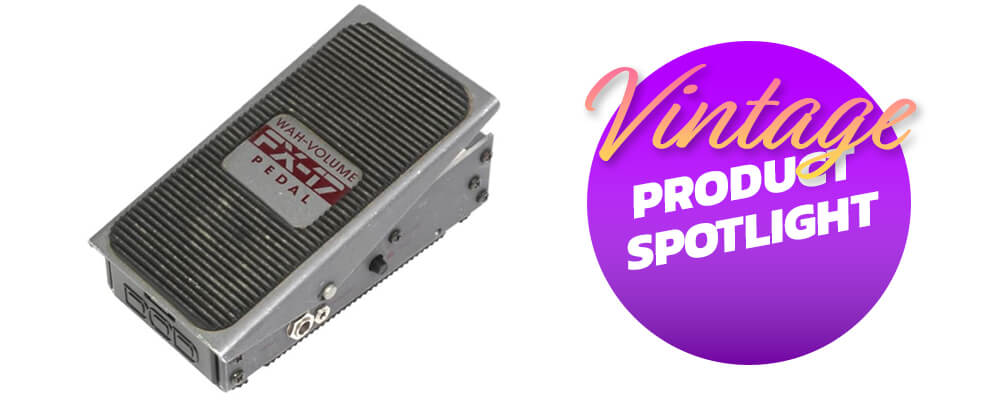
In this issue, we’re taking a look back at a true under-the-radar classic the DOD FX17 Volume Wah pedal. At first glance it looked like a straightforward treadle pedal, but the FX17 packed a surprising amount of versatility into its rugged frame. With a simple side switch, players could move between wah and volume modes, and it even doubled as a 0 to +5 volt controller for synth gear and other effects. That kind of flexibility was rare at the time, making it a quiet favorite for players who wanted more out of a single pedal.
What really made the FX17 stand out was its forward thinking design. Instead of relying on traditional string and potentiometer systems that would wear out over time, DOD used a proprietary mechanism to eliminate those common failure points. That meant no scratchy pots, no broken strings, and a much more durable feel under your foot. Add in its heavy steel construction, internal trim controls for shaping the wah sweep, and a tone that players often described as clean and unique, and you had a pedal that felt built for the long haul while still sounding different from the crowd.
So why did it disappear? Like a lot of pedals from the late 80s and 90s, the FX17 quietly faded out as the market shifted. Production likely stopped in the late 90s, and by around 2000 it was gone. Part of that came down to changing player preferences and increased competition, but also practicality. Its unique power requirements and unconventional design made it a little less plug and play compared to newer options. Even so, the FX17 remains a cult favorite today, remembered as a creative, durable pedal that was just a bit ahead of its time.
— Until next time, keep creating! —